![[WOI] NewsBot](/data/avatars/m/33/33004.jpg?1732189642)
The verdict, in favor of major record labels including Sony and Universal, was a catalyst for many other ‘repeat infringer’ lawsuits. This resulted in yet more multi-million dollar claims and awards, with many still in the pipeline today.
Meanwhile, Cox did everything it could to fight the verdict, all the way up to the Supreme Court, which formally heard the case last December. The panel had to decide whether an ISP can be held liable for not taking any action in response to piracy notices, which which the Court answered today with a clear no.
Supreme Court Reverses: Knowledge is Not Intent
In a 7-2 decision handed down this morning, the Court reversed the Fourth Circuit decision, ruling that Cox is not contributorily liable for the infringing actions of its pirating subscribers. The opinion was written by Justice Thomas and is joined by six other justices. Justices Sotomayor and Jackson concurred, but disagreed sharply with the majority’s reasoning.
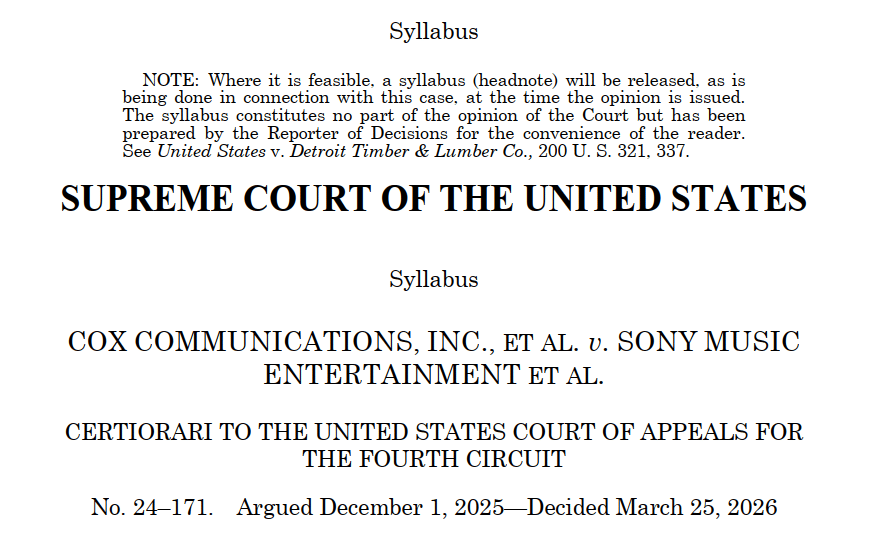
The opinion states that contributory liability requires proof that the provider intended its service to be used for infringement. That intent can only be shown in one of two ways. Either the provider actively induced infringement, or the service is one that has no substantial non-infringing uses.
In the present case Cox met neither test. It never encouraged its subscribers to pirate anything. And internet access, as the Court noted, is used for countless lawful purposes.
“Under our precedents, a company is not liable as a copyright infringer for merely providing a service to the general public with knowledge that it will be used by some to infringe copyrights. Accordingly, we reverse,” Justice Thomas writes.
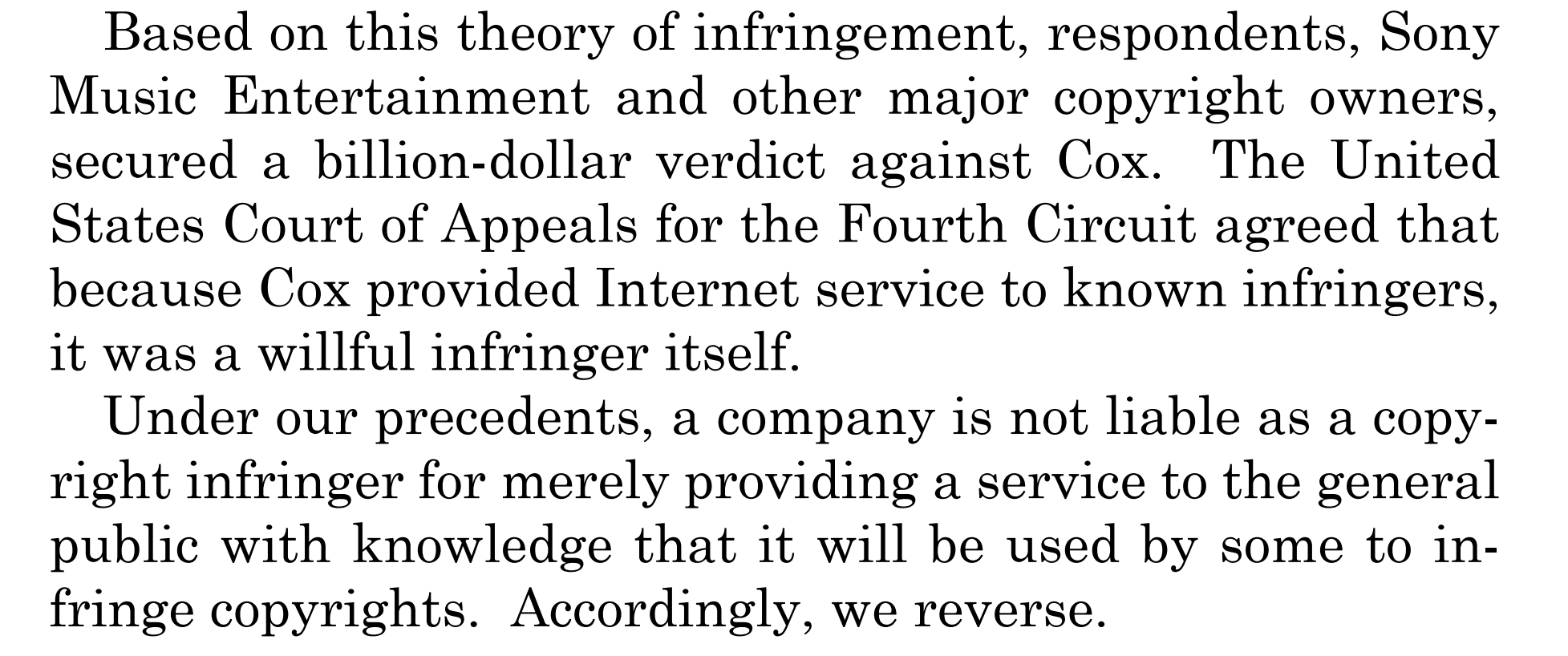
The Court also directly countered the Fourth Circuit’s reasoning, which held that supplying a product with “knowledge” of future infringement was enough to establish liability. The Supreme Court called this an improper expansion of copyright law that conflicted with decades of precedent.
This means that Cox may have known about the infringing activity of its subscribers, but that they are not liable for not taking action in response.
The “IP Address” Problem
In a concurring opinion, Justice Sotomayor agreed that Cox shouldn’t be held liable, but for a more practical reason. Under the common-law aiding-and-abetting doctrine, which she argued the majority should have applied, liability requires proof that a defendant intended to help a specific wrongful act succeed.
Sotomayor noted that when the anti-piracy tracking company MarkMonitor flagged an infringing IP address, it only identified a connection, not an individual. Whether the infringer was a specific account holder, a roommate, or a neighbor stealing Wi-Fi remained a mystery.
Without knowing who was actually infringing, Sotomayor argued, it is impossible to prove Cox intended to help that specific person succeed in their “wrongful act”.
Is the DMCA Safe Harbor Now “Obsolete”?
The ruling leaves a massive question mark over the future of the Digital Millennium Copyright Act (DMCA). Sony argued that the DMCA’s “safe harbor” provisions, which require ISPs to terminate “repeat infringers”, would be meaningless if ISPs weren’t already liable for serving those infringers in the first place.
Justice Sotomayor went even further, warning that the majority’s new rule “consigns the safe harbor provision to obsolescence”, adding that ISPs now have little incentive to take any action against online pirates.
“The majority’s decision thus permits ISPs to sell an internet connection to every single infringer who wants one without fear of liability and without lifting a finger to prevent infringement,” she notes.
What Happens Next
With today’s opinion, the case is reversed and remanded to the Fourth Circuit for further proceedings. Whether the music labels will pursue further litigation on remand, and what that would look like, remains to be seen.
For rightsholders, the ruling removes the primary legal tool they have used to pressure ISPs to terminate infringers more aggressively. For ISPs, however, it resolves years of uncertainty about how far they have to go in response to copyright infringement notices. Whether that means that they will indeed take less action has yet to be seen.
—
A copy of the Supreme Court’s opinion is available here (pdf). This is a developing story; more quotes, comments, and notes may be added later.
From: TF, for the latest news on copyright battles, piracy and more.
Continue reading...


![[WOI] NewsBot](/data/avatars/s/33/33004.jpg?1732189642)