![[WOI] NewsBot](/data/avatars/m/33/33004.jpg?1732189642)

Apple’s action wasn’t completely unexpected. Music industry groups had been trying to take Musi down for a long time, branding it a ‘parasitic’ app that skirts the rules.
Delisting from the App Store was an existential threat to Musi, which took the matter to court. Musi claimed that the App Store removal was the result of “backroom conversations” between Apple and key music industry players, including Sony, IFPI, and YouTube.
The app developer accused Apple of breach of contract and breach of the implied covenant of good faith and fair dealing. The company hoped that the court would agree and compel Apple to reinstate the app, but that did not happen.
Court Dismisses Musi’s Complaint
In an order issued yesterday, Judge Eumi K. Lee of the U.S. District Court for the Northern District of California dismissed the case with prejudice, effectively ending the lawsuit.
In its defense, Apple has argued that the terms of the Apple Developer Program License Agreement (DPLA) allowed the company to delist apps “at any time, with or without cause.” That would be sufficient to remove Musi.
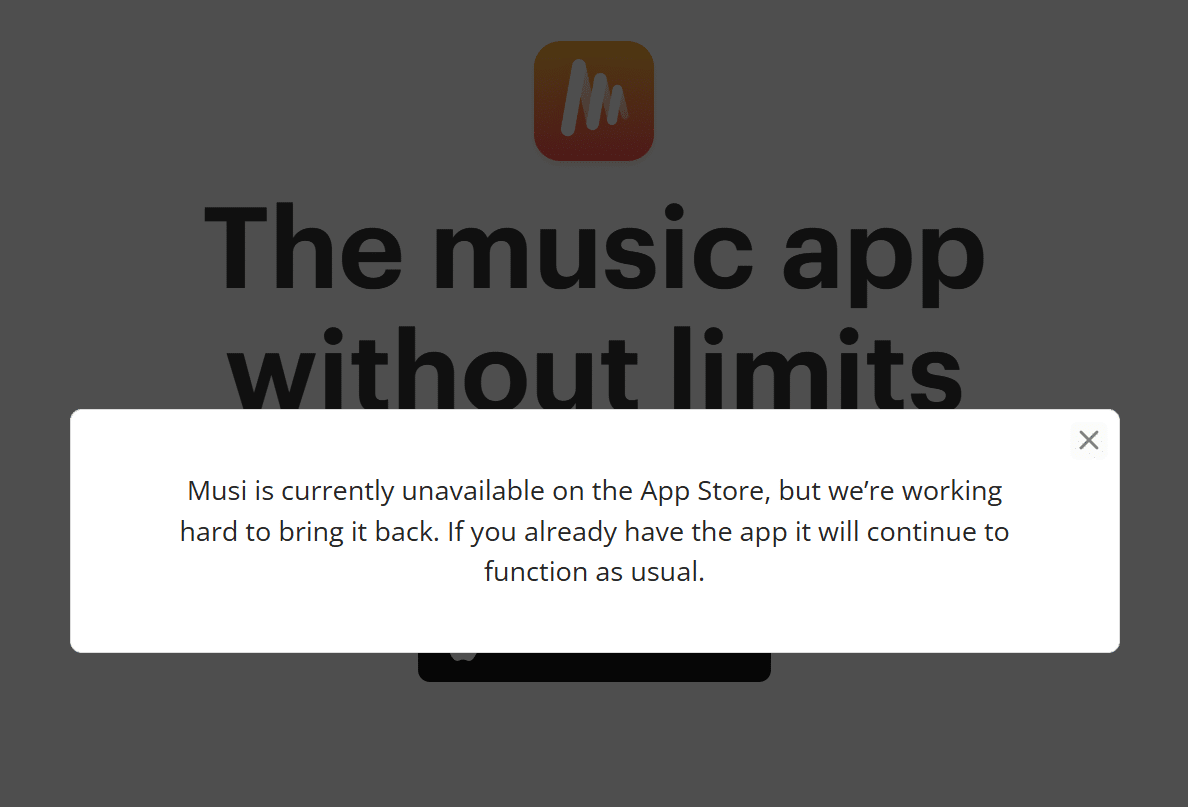
Musi website
Musi has countered that, according to the same agreement, Apple needed to conduct a review to establish “reasonable belief” before an app would be removed from its platform. However, the court disagreed, stressing that there are no limitations to Apple’s removal rights.
Dismissed
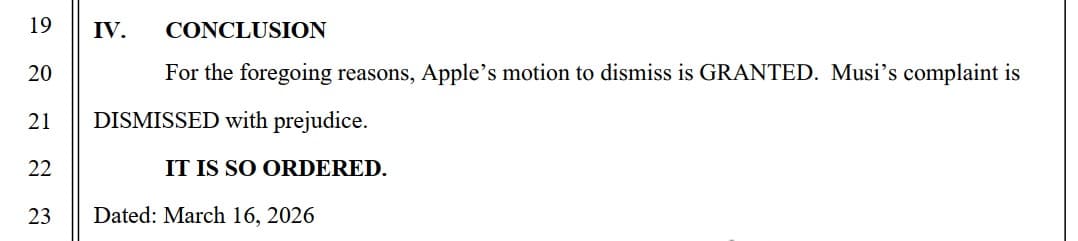
“There is simply no textual basis in the DPLA to construe a limitation on Apple’s right to cease offering an application, as long as Apple provided notice,” Judge Lee writes.
Musi’s Claims Fail
Musi’s argument that Apple breached an “implied covenant of good faith” under California law also failed. While Apple was contractually allowed to remove the app, the court notes that Apple did not solely act in response to the YouTube claim.
“[T]he complaint reflects that Apple was facing pressure from multiple music industry complaints. The letter from Sony expressly states that its trade organization (the IFPI) had already tried to resolve issues with Musi through the app dispute process, but Musi was not cooperating,” the order reads.
The court already granted Musi the option to amend its complaint previously and allowed two months of discovery, including access to over 3,500 documents and depositions from Apple officials, but that was not enough. Therefore, the court dismissed the case with prejudice, meaning that it can’t be refiled.
Sanctions Against Musi’s Lawyers
In a separate order issued the same day, the court granted Apple’s motion for Rule 11 sanctions in part, ruling that one allegation in Musi’s amended complaint was factually baseless.
Musi had alleged in the first paragraph of its amended complaint that Apple “knew that this ‘evidence’ was false, as it has since admitted.”
Judge Lee found that this admission did not appear anywhere in the provided evidence. Therefore, Musi’s claim that Apple had “admitted” to knowingly relying on false evidence is sufficient to warrant sanctions.
“Claiming that Apple ‘admitted’ that it knowingly relied on false evidence conveys that discovery yielded damning evidence,” the order states, “but it did not.”
The sanctions order effectively removed the offending phrase from the amended complaint and ordered Musi’s law firm, Winston & Strawn LLP, to pay Apple’s reasonable attorneys’ fees related to the sanctions motion.
More Scrutiny
The sanctions ruling was not the first time Musi’s honesty came under scrutiny in this case. In a motion filed in May 2025, Apple alleged that Musi had previously impersonated a Universal Music Group executive to get its app reinstated after an earlier removal.
Apple claimed that Musi founder Aaron Wojnowski forwarded a fabricated email to Apple purportedly from UMG’s Jason Miller, using the address [email protected], which is not a UMG address.
Forwarded email
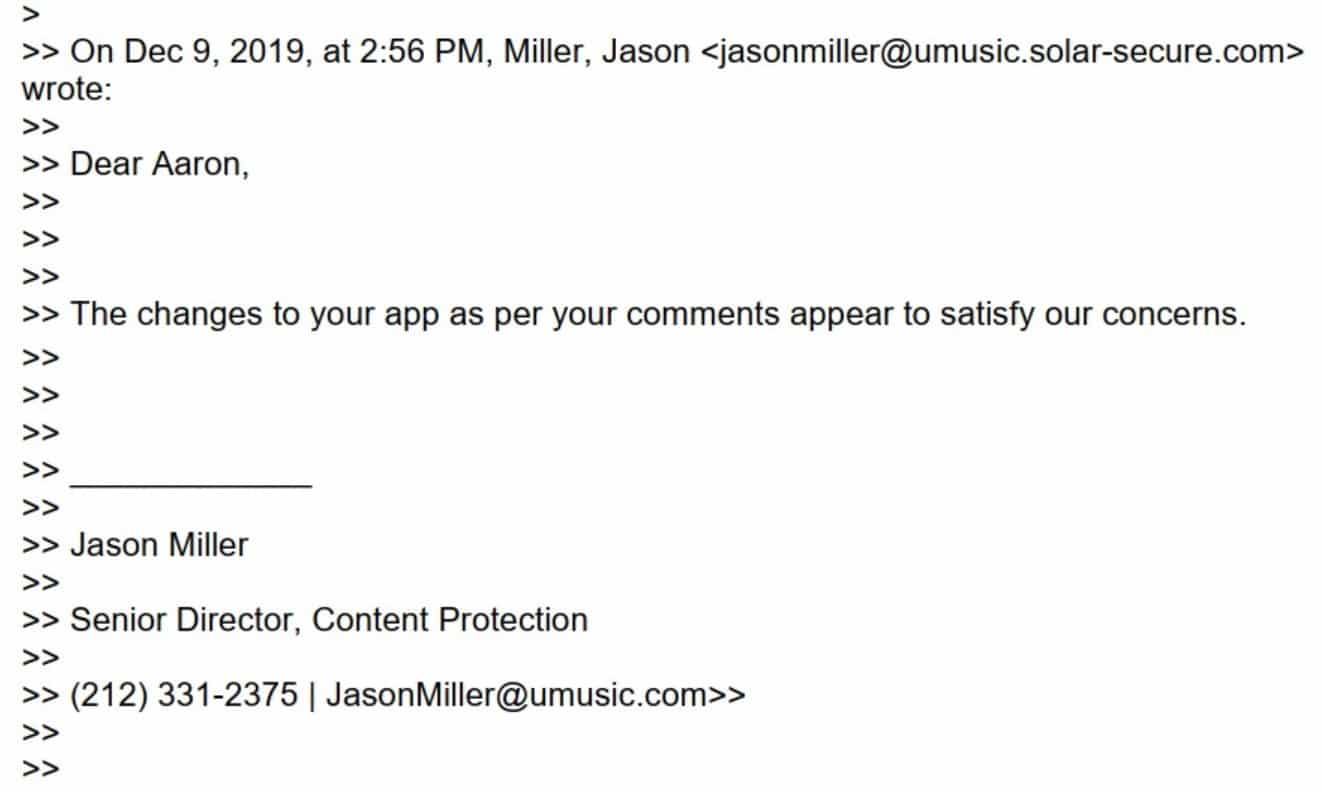
UMG later informed Apple the email was “fraudulent” and that Miller had no record of sending it. The same address was allegedly used to file a false copyright claim against a separate music streaming app, Yokee, in July 2020.
With the dismissal order now in place, the case is effectively closed. This means that the once very popular music app will not return to the App Store via this route. Musi still has the option to appeal, but whether it plans to do so is unclear. The company did not immediately return our request for comment.
—
A copy of Judge Eumi K. Lee’s order granting Apple’s motion to dismiss is available here (pdf). The order granting in part Apple’s motion for Rule 11 sanctions is available here (pdf).
From: TF, for the latest news on copyright battles, piracy and more.
Continue reading...


![[WOI] NewsBot](/data/avatars/s/33/33004.jpg?1732189642)