![[WOI] NewsBot](/data/avatars/m/33/33004.jpg?1732189642)

To effectively tackle live sports piracy, its broad blocking powers aim to block piracy-related domain names and IP addresses within 30 minutes.
While many pirate sources have indeed been blocked, the Piracy Shield is not without controversy. There have been multiple reports of overblocking, where the anti-piracy system blocked access to legitimate sites and services.
€14,247,698 ‘Piracy Shield’ Fine
Cloudflare was caught up in several of those incidents and became one of Piracy Shield’s most prominent critics. Following an amendment that extended the scheme’s reach to DNS providers and VPNs, the American Internet infrastructure company refused to filter pirate sites through its public 1.1.1.1 resolver, arguing that it was unreasonable and disproportionate.
In response to the refusal, Italy’s communications regulator AGCOM launched a formal investigation. In January, the regulator concluded that Cloudflare has all the technological expertise and resources to implement the blocking measures. AGCOM argued that the company is known for its complex traffic management, and rejected the suggestion that complying with the blocking order would break its service.
After weighing all arguments, AGCOM imposed a €14,247,698 (USD $16.4m) fine against Cloudflare for failing to comply with the required anti-piracy measures. The regulator added that this fine represents 1% of the company’s global revenue, adding that the law allows for a maximum of 2%.
Cloudflare Formally Appeals
This week, Cloudflare explained in a blog post why it formally appealed the fine on March 8. According to the company, this case is about more than money, as it believes that the Piracy Shield blocking regime puts the open Internet at risk.
The company stresses that the controversial pirate site blocking system essentially operates as a “black box”.
“This case isn’t just about a single penalty; it’s about whether a handful of private entities can prioritize their own economic interests over those of Internet users by forcing global infrastructure providers to block large swaths of the Internet without oversight, transparency, or due process,” Cloudflare notes.
Black-Box
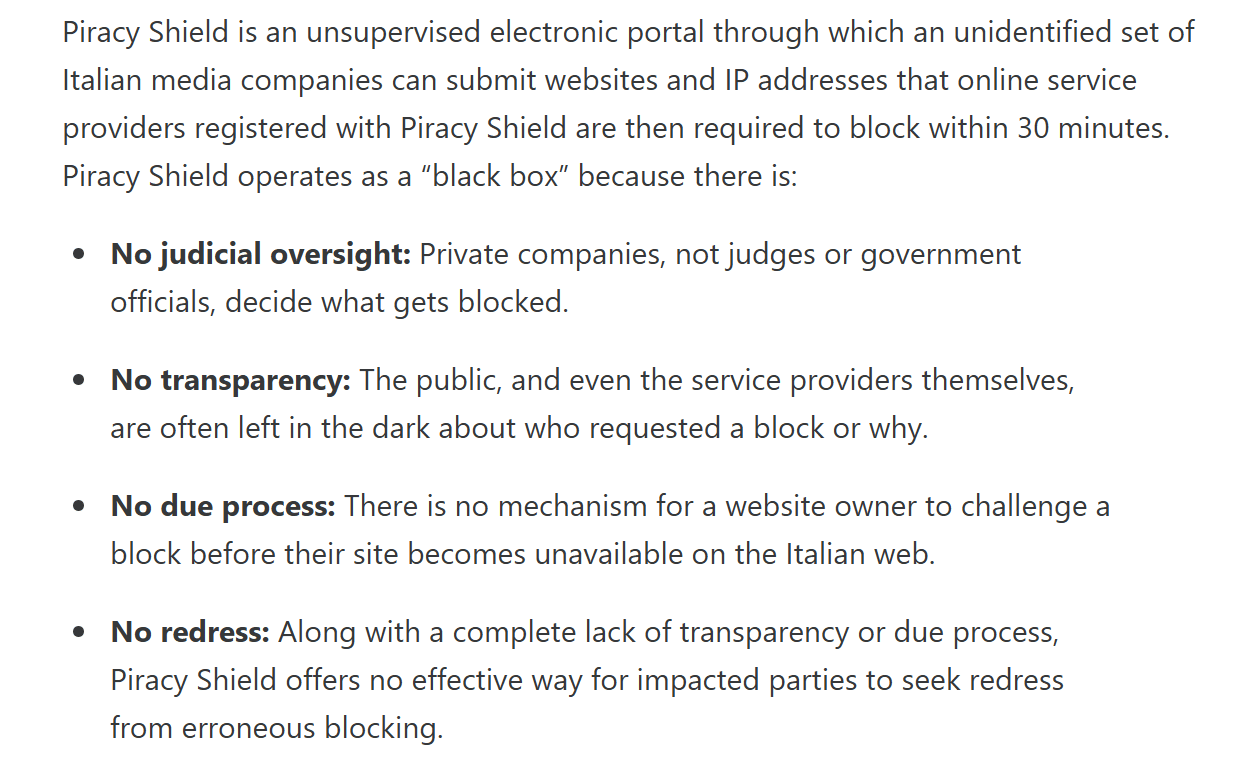
Cloudflare further stresses that the Piracy Shield’s flaws and shortcomings are no accident. In its blog post, the company points out that Piracy Shield was “donated” to the Italian government by SP Tech, an arm of the law firm that represents several of the scheme’s direct beneficiaries, including the Serie A, Italy’s top soccer league.
Failures and Flaws
Cloudflare once again reiterates that the Piracy Shield scheme is a blunt instrument that created an unavoidable risk of overblocking. This includes many innovative sites and services, including Government websites, educational resources, and access to Google Drive, which were all blocked at some point.
This massive overblocking and collateral damage was also confirmed in a study by researchers from the University of Twente last September. They concluded that Piracy Shield is linked to “significant collateral damage to legitimate infrastructure” and may pose a “potential threat to national security.”
AGCOM has been aware of the critique, including the European Commission’s concerns, but it continues to stay the course. Instead of limiting the impact, it broadened the scheme to include DNS resolvers and VPNs.
“Even when faced with clear evidence that Piracy Shield has caused significant and repeated overblocking, AGCOM did not change course. Rather, it chose to expand Piracy Shield to apply to global DNS providers and VPNs, services which are closely associated with privacy and free expression,” Cloudflare writes.
Challenging Piracy Shield’s Legality
In addition to overblocking concerns, Cloudflare also stresses that the Piracy Shield lacks transparency. These and other issues will likely be brought up during the appeal, which will also question the amount of the fine.
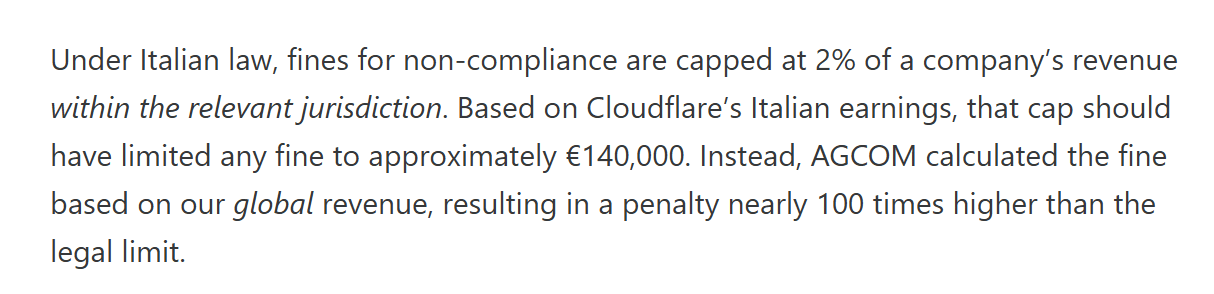
AGCOM previously noted that the €14 million fine is less than the legally permitted 2% of Cloudflare’s global revenue. However, Cloudflare counters that Italian non-compliance fines are capped at 2% of a company’s revenue within the relevant jurisdiction, which would be approximately €140,000, not 100 times that.
100 times higher
All in all, the company says that it will continue to challenge the controversial piracy blocking scheme to the best of its ability.
“We are not backing down. Cloudflare is appealing the €14 million fine, pushing for full access to AGCOM’s Piracy Shield records, and will continue to challenge the underlying legality of the Piracy Shield blocking orders in the Italian administrative courts,” Cloudflare notes.
From: TF, for the latest news on copyright battles, piracy and more.
Continue reading...


![[WOI] NewsBot](/data/avatars/s/33/33004.jpg?1732189642)