![[WOI] NewsBot](/data/avatars/m/33/33004.jpg?1732189642)

To curb this trend, music companies have taken legal action against various stream-ripping services. This includes Yout.com, which is operated by the American developer Johnathan Nader.
Nader is not easily defeated, however. In 2020 he took the RIAA to court in an attempt to have the site declared legal.
Appeal Pending
At the end of 2022, the district court handed a win to the RIAA and dismissed the matter at an early stage. Judge Stefan Underhill concluded that Yout had failed to show that it doesn’t circumvent YouTube’s technological protection measures. As such, it could be breaking the law. That wasn’t the end though.
Yout’s operator opted to appeal at the Court of Appeals for the Second Circuit, asking it to reverse the lower court’s decision. The stream-ripper’s arguments are partly supported by amicus briefs from GitHub and the EFF, both of which joined the case.
On the other side of the aisle, the RIAA dug in its heels. The music group saw no reason to doubt the lower court’s position and, in its response to the appeal, found the Copyright Alliance at its side.
Yout Flags Cox Supreme Court Precedent
The Second Circuit appeal has been pending for a while, but some fresh arguments appeared this week, after the Supreme Court issued its ruling in Cox v. Sony, reversing a billion-dollar verdict against the internet service provider and narrowing the standard for contributory copyright liability.
Yout’s lawyers were quick to flag the decision to the Second Circuit via a supplemental authority letter. They argued that the Supreme Court’s discussion of when a service is ‘tailored to infringement’ has bearing on Yout’s own situation.
“Although Cox Communications is not an anti-circumvention case, it nonetheless may provide useful guidance to the Court in the present case as the Supreme Court discusses when a ‘service is tailored to infringement’,” Yout’s counsel wrote.
From the letter
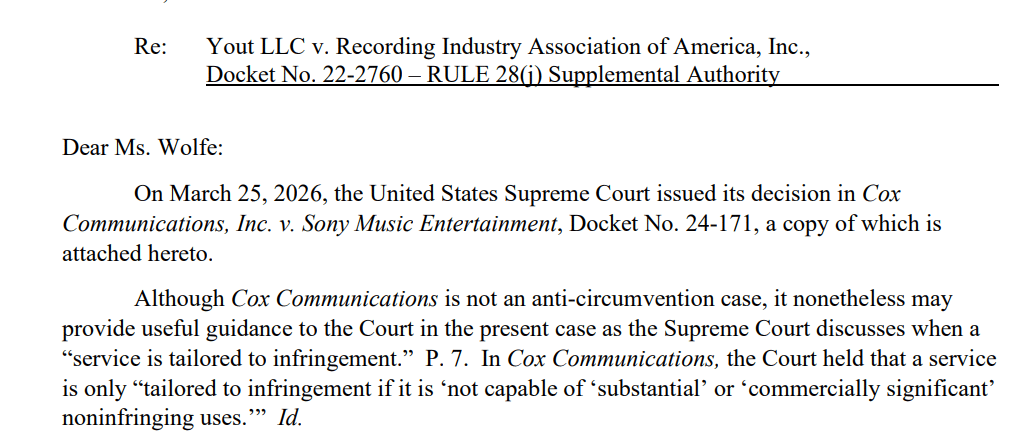
The Supreme Court held that a service that has noninfringing uses cannot be held liable, even if the operator knows that the service may be used for copyright infringement. Yout suggests the same logic should apply in its case.
RIAA: Cox Does Not Apply
Shortly after Yout informed the court, the RIAA sent a direct response.
“Yout’s letter is not helpful to the resolution of this case,” RIAA writes. “The Cox decision addresses common law contributory liability for infringement. Yout’s complaint involves statutory anti-circumvention claims.”
The distinction matters according to the RIAA, as the anti-circumvention of the DMCA (Section 1201) operates independently of the contributory liability doctrine. This means that a technology with noninfringing uses can still be prohibited under Section 1201, if it meets one of three criteria.
Under 17 U.S.C. §§ 1201(a)(2) and 1201(b)(1), liability for trafficking exists if a technology or service meets any one of these three disjunctive criteria:
- It is primarily designed to circumvent technological measures that effectively control access to copyrighted works.
- It has only limited commercially significant purposes other than to circumvent.
- It is marketed as circumvention tool.
RIAA argues that all these criteria are met here, as Yout is designed to let users save local copies of YouTube content, its revenue model depends on that downloading functionality, and it markets itself explicitly as a stream recording tool, while borrowing the first four letters of YouTube’s name.
Whether this exchange of opinions will influence the Second Circuit’s eventual decision has yet to be seen. The key issue on appeal remains whether YouTube’s rolling cipher qualifies as a technological protection measure under Section 1201 of the DMCA, and whether Yout circumvents it.
—
A copy of Yout’s Rule 28(j) letter is available here (pdf). The RIAA’s response can be found here (pdf).
From: TF, for the latest news on copyright battles, piracy and more.
Continue reading...