![[WOI] NewsBot](/data/avatars/m/33/33004.jpg?1732189642)

In general, the public doesn’t view piracy as outright stealing or morally wrong. In fact, many people see ‘unauthorized copying’ as morally justified, even if it costs rightsholders billions.
There are also religious people who pirate music, films, and software. While these people all have their own reasons, how they practice their religion appears to have a significant impact on how likely they are to pirate. In some cases, religion can even increase the tendency to pirate, a new study suggests.
Research: Piracy & Religion
A new paper titled “Software Piracy: The Effects of Neutralization and Religiosity,” published in the Journal of the Southern Association for Information Systems, investigates how an individual’s religious beliefs affect their intention to engage in software piracy.
The paper
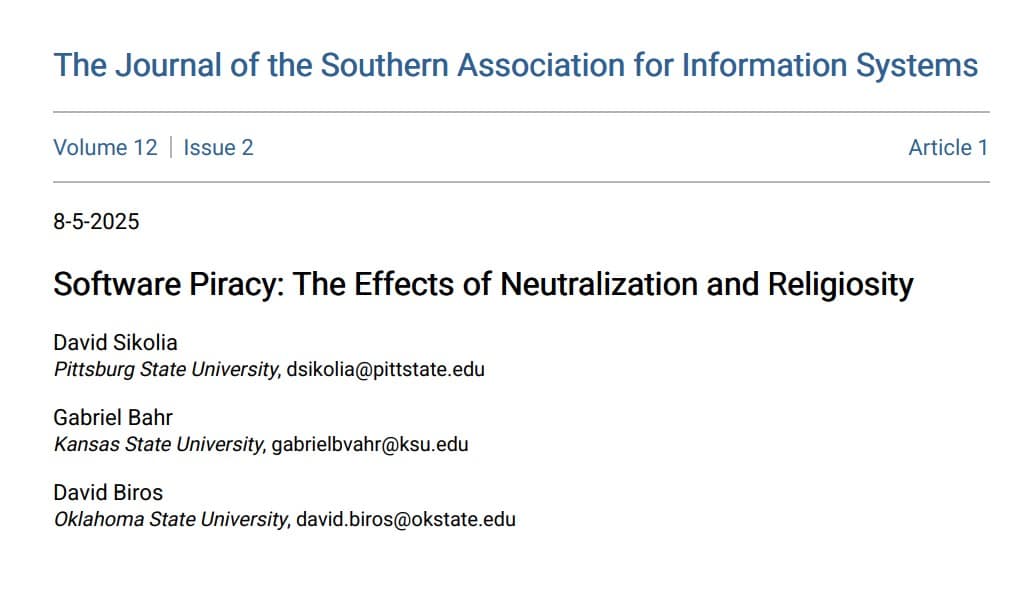
Researchers from Pittsburg State, Kansas State, and Oklahoma State University developed a model combining religiosity theory with neutralization to examine how the effect of religion on piracy intentions can differ.
The research draws on the psychological distinction between intrinsic and extrinsic religiosity, which differs from person to person.
Intrinsic religiosity typically involves deeply internalized religious beliefs and living one’s life according to those beliefs. Extrinsic religiosity is more focused on using religion for personal or social benefits, such as being a respectable member of the community, identifying with a religious group, or finding psychological comfort in faith.
The researchers hypothesized that how people identify with their faith will affect their intention to engage in piracy. This was tested in a survey among 338 undergraduate business students in the United States, who had to review a software piracy scenario and were asked to rate the likelihood that they would do the same.
Religion Impacts Piracy Habits
The findings show that the degree of intrinsic and extrinsic religiosity has a significant impact on the intention to pirate.
Intrinsic religiosity was negatively correlated with the intention to pirate. This suggests that individuals who have deeply internalized religious and moral values are less likely to pirate software.
Extrinsic religiosity correlated positively with the intention to pirate software. This implies that individuals motivated by the social or utilitarian benefits of religion may be more likely to justify unauthorized downloading of software.
The driving factor behind these findings is the use of rationalization techniques or, boldly put, excuses. Those who pirate typically come up with rationalizations for their behavior, and that’s also shown by the research. Three rationalization techniques were significant predictors of piracy intention.
rationalization techniques
Condemn the Condemners: Justifying piracy by viewing software companies as greedy or copyright laws as unfair.
Appeal to Higher Loyalties: Rationalizing piracy as helping friends or promoting free culture.
Metaphor of the Ledger: Focusing on good deeds in other areas of life that compensate for their piracy actions.
The researchers conclude that these rationalizations can directly involve religion for those who have an extrinsic religious orientation.
“Those with extrinsic religiosity are more likely to have utilitarian motives and are less likely to have genuine ethical intentions. If I attend church and do other good things, then it is all right if I pirate a little software now and then (metaphor the ledger),” the paper reads.
The Anti-Piracy Gospel
In addition to these key findings, the study also confirmed earlier research finding that men are more likely to pirate than women, and that older people are less inclined to pirate software than their younger counterparts.
The research shows that people’s tendency to pirate is influenced by a combination of internal moral compass and the ability to rationalize piracy. That said, the findings are based on a sample of business students, which means that they may not be representative of the general population.
Intriguingly, the researchers suggest that their findings could make it worthwhile to involve religious organizations in anti-piracy campaigns.
“Religious organizations can play a key role in educating communities about the ethical issues of piracy by using sacred teachings to promote honesty and respect for others’ work. They can address piracy in sermons, host educational workshops, and incorporate digital ethics into youth programs,” they write.
Whether any anti-piracy groups are eager to pick this up is unknown.
—
Sikolia, D., Bahr, G., & Biros, D. (2025). Software Piracy: The Effects of Neutralization and Religiosity. The Journal of the Southern Association for Information Systems, 12, 1-17. https://doi.org/10.17705/3JSIS.00038
From: TF, for the latest news on copyright battles, piracy and more.
Continue reading...


![[WOI] NewsBot](/data/avatars/s/33/33004.jpg?1732189642)