![[WOI] NewsBot](/data/avatars/m/33/33004.jpg?1732189642)

The music publishers, meanwhile, were busy in a different court, asking a Texas judge to throw out X’s antitrust complaint against them with similar finality.
The motion to dismiss, filed in the Northern District of Texas, argues that X’s lawsuit doesn’t hold up and the music companies want all eight counts dismissed with prejudice.
A Conspiracy Built on One Word
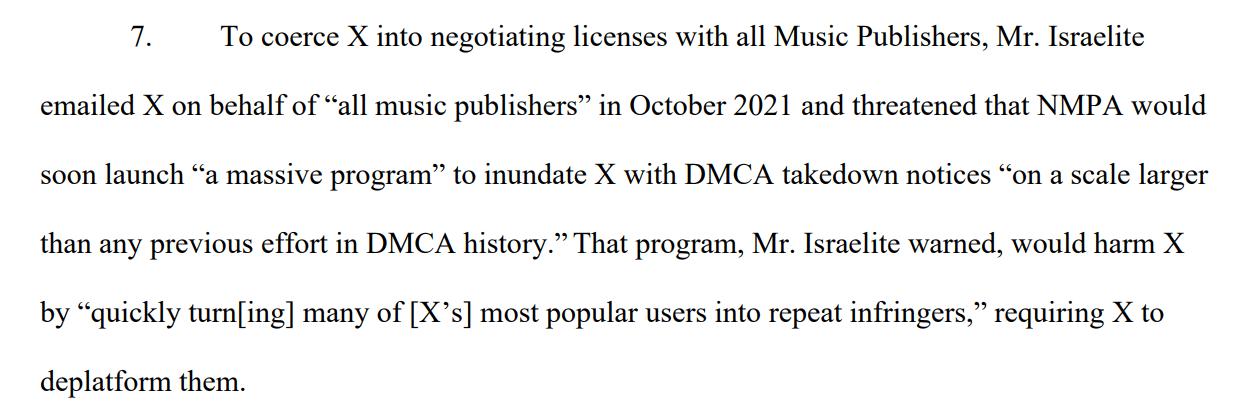
X filed its antitrust complaint in January, accusing the National Music Publishers’ Association (NMPA) and a coalition of major music publishers, including Sony, Universal, and Warner Chappell, of coordinating a “weaponized” DMCA takedown campaign to coerce X into industry-wide licensing deals.
The conspiracy claim rested heavily on a pre-litigation email sent by NMPA President David Israelite to Twitter in October 2021. X alleged that Israelite threatened a “massive program” of DMCA notices on a scale “larger than any previous effort in DMCA history” if X did not agree to a partnership.
From X’s January complaint
However, the publishers have now submitted the full email chain to the court, arguing that X’s complaint “selectively crops, paraphrases, and misconstrues” it. They note that the complete exchange tells a more nuanced story.
In his October 6 email, Israelite warned Twitter that the NMPA was preparing a “massive program” of DMCA notices, adding that his “preference is not to go down that road, but instead to develop a partnership.” He closed by writing (emphasis added): “If you are interested in engaging in such a conversation, please let me know. If you choose not to do so, then please know we are open to starting a conversation at any point during the future process.”
The first email
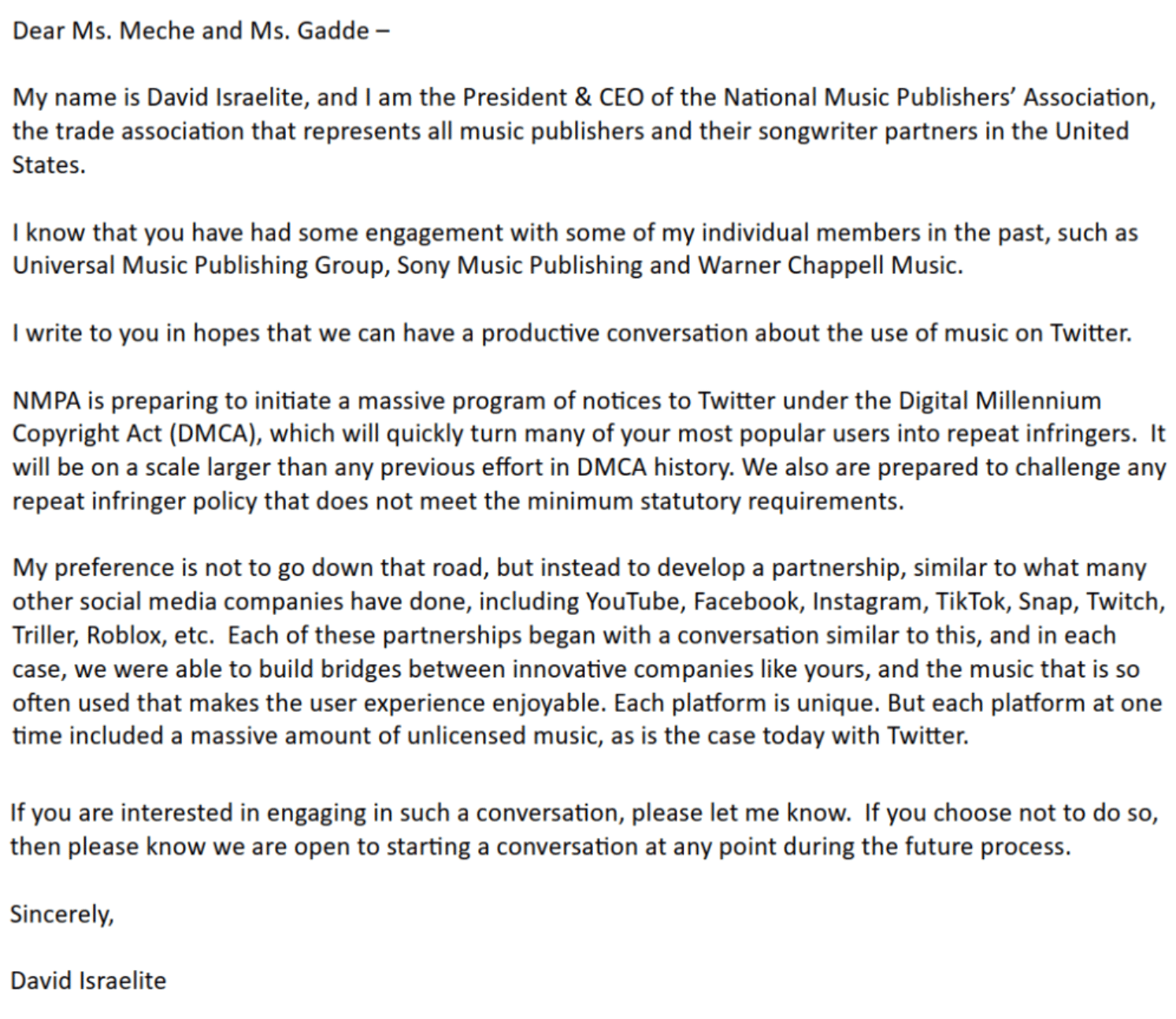
The publishers argue that X’s conspiracy theory rests almost entirely on that final word.
“X argues that by using the word ‘we,’ NMPA meant that X could only deal with the Music Publishers collectively for a license and that no individual Music Publisher would negotiate separately. That inference is not only implausible, it is completely devoid of factual basis or allegation. An antitrust claim cannot rest on such a tenuous thread.”
Same Judge, Same Problem
One of the key reasons for a dismissal is the argument that there can be no antitrust injury, as X and the music publishers do not compete. The music companies argue that antitrust law requires a competitor to be involved in a refusal-to-deal claim.
The argument has already succeeded once against X, in the same courthouse, before the same judge. In February, District Judge Jane Boyle dismissed X’s antitrust lawsuit against the World Federation of Advertisers with prejudice, finding that X had failed to allege antitrust injury because no competitor was involved in the alleged boycott.
The publishers quote that ruling extensively and argue the present case is largely similar.
“Specifically, X does not allege that any participant in the alleged conspiracy is its competitor, a necessary requirement for antitrust injury to flow from an alleged refusal to deal,” the motion states.
The proposed order submitted alongside the motion has Judge Boyle’s name pre-filled.
Retaliation, Not Antitrust
The music publishers take their motion to dismiss beyond simply refuting X’s claims. They also suggest that X filed the antitrust suit as leverage in the copyright infringement case the music companies filed in the Tennessee federal court.
“The paucity of factual allegations supporting an antitrust claim is no accident. X’s motivation in filing suit was different: retaliation and leverage for the copyright suit the Music Publishers filed against it, which is currently pending in Tennessee federal court,” the motion notes.
X argues that the music companies sent a flood of “baseless” DMCA notices, targeting over 200,000 posts and suspending 50,000 users. However, the music publishers motion counters that none of the takedown notices was objectively baseless.
The Sham Exception
The music companies argue that their takedown campaign was a First Amendment-protected pre-litigation activity. They invoke the Noerr-Pennington doctrine, which shields things such as pre-litigation notices and cease-and-desist letters from antitrust liability.
DMCA takedown notices, they argue, fall in the same category, especially since these were used as key evidence in the the copyright lawsuit currently pending in Tennessee.
This type of protection does not apply if the notices themselves are “baseless” or a “sham,” which X argued is the case here. The original complaint pointed to several examples, including a takedown notice targeting a video where the non-commercial use of background music was flagged as copyright infringement.
The music companies, however, counter that X does and cannot claim that any notices were baseless. This includes the background music example: this may qualify for fair use defense, but the publishers add that “infringing use of incidental background music is still infringing.”
All in all, the motion to dismiss concludes that the music companies used the DMCA as Congress intended, and that it is not an antitrust violation. The complaint should therefore be dismissed with prejudice on all counts.
It is now up to Judge Boyle to decide whether the antitrust case can continue or whether it should be dismissed outright. The same is true for the Nashville case, where X asked the court to completely dismiss the music companies’ copyright infringement lawsuit.
—
A copy of the motion to dismiss, filed April 2, 2026 at the U.S. District Court for the Northern District of Texas, is available here (pdf). The supporting memorandum can be found here (pdf).
From: TF, for the latest news on copyright battles, piracy and more.
Continue reading...


![[WOI] NewsBot](/data/avatars/s/33/33004.jpg?1732189642)